« December 2006 | Main | February 2007 »

January 31, 2007

What We Need Is A National Day of Rest

gwcubamug.jpg

"Who says nothing is impossible? Some people do it every day."
- Alfred E. Neuman

Connecting the Dots
by Glynn Wilson

If life imitates art far more than art imitates life, as Andy Warhol and Oscar Wilde both contended, then what are we to make of Alfred W. Bush?

What, me worry?

Blah, blah. Jibber, jabber.

I am just a humble reporter, right? So what do I know about art - or running a country?

267_avatar.gif

Nothing.

But I do know something about doing nothing and doing the impossible.

I do nothing almost every day.

Every once in a great while, I will gear myself up and do the impossible, like stopping a river from being dammed or a road from being built.

I once wrote a story with the zany, sensational headline: "Endangered Sea Turtles Killed by City Street Lights."

The result was a new policy in the city of Gulf Shores, Alabama, to turn off the streetlights for two weeks every year - while the loggerhead sea turtles hatch on the Gulf Coast. You see, when the hatchlings come out of their holes in the sand, they are driven genetically to the moon shining off the ocean water. It's natures of way of telling them what direction to crawl to survive.

When they crawl out and see the street lights, well, they head for the road - and a bad fate.

So what if we as a country decided to just turn out the lights for a day?

I'm not kidding.

What I am proposing is a bona fide national strike to protest all that is wrong in the world.

To all my activist friends, what about it?

What we need is not a national day of protest. What we need is a national day of rest.

Wouldn't it be grand to see the media jump all over themselves covering a story about a country completely shutting down because no one shows up for work?

We'll let the media off the hook on this one. They have to work even on Christmas and the Fourth of July.

When the power shuts down and the phones don't work and the Internet crashes, someone in Washington will freak out and wonder where all the people have gone.

Look at it this way. Consider how much energy we could save in one work day just by staying home and doing nothing.

According to the federal government, every day America burns 1 million Btus of energy for every man, woman and child in the U.S. The average single-family household in the U.S. consumes a little more than 100 million Btus every year.

A national day of rest would save enough energy to keep us out of any more wars in the Middle East, and we would not have to consider drilling for oil in the Arctic National Wildlife Refuge in Alaska or within 100 miles of the Florida coast.

We would not have to consider chopping down entire forests and turning all the trees into wood chips to make a new and strange form of biofuel.

So what about it? If you are pissed off about anything, anything at all, won't you join me in this strike? This national day of rest?

Don't call in sick. Just don't show up.

And turn off your lights. You might find that you have a strange new peace of mind that you have never experienced before. You might experience some peace and quiet for a change. And we might all be the better for it.

Alfred W. Bush could spend the day on his Crawford, Texas, ranch, and think about life, art - or his legacy.

Who knows? We could come out of it a better country. Maybe the world would join us and we could have a worldwide day of rest.

Talk about saving the world, and savoring life

January 16, 2007

On Technological Ch-Che-Change...

gwcubamug.jpg

Connecting the Dots
by Glynn Wilson

There is no accounting for taste, or for how people learn and use new technology.

While I am an avid student of how people use the Internet, especially, I hate to be called a preacher or even a teacher. Although I've been called both - sometimes as a compliment; sometimes not.

But I've been thinking lately that it would not be a bad idea to start one's own church in the good old US of A, considering the penchant on the part of the masses to search out someone else with the aura of authority to tell them what to think and how to live - and considering the tax laws.

Present company excluded, of course, since I suspect most of the readers lurking here are more likely to search out a great watering hole than a church. But there are several points worth considering for even the most intelligent audience in what I am about to say.

One of the smartest guys to ever walk the earth, Albert Einstein, once said: "Technological change is like an axe in the hands of a pathological criminal."

There is a lot of technological change going on. Some for good; some for bad. And there are some attempts being made to explain it, but you have to search them out - or find a journalist or blogger to find them for you and provide a free and easy summary you can get to on your computer screen.

That is my job, in a way. So here goes.

Let's start with technological changes going on with the most popular technology of them all, television. We'll get around to explaining some things about the Web Press in the end.

There is a technological war going on and it WILL effect how you live and work in the future, whether you know it or like it or not.

And it is hard to find anyone who can explain it in a meaningful way. I'm not even sure I can do it yet, so the conversation will have to continue in an ongoing way that can only be accomplished today on a blog.

Due to some recent technological failures around the home front, namely the demise of a six-year-old, 32-inch RCA television, we've had to face up to some changes in TV Land.

In about three years, the corporate network TV business will abandon the public analogue spectrum available over the free, public airwaves - available with an antennae. All the television you get at that point - from cable or satellite - will be in High Definition format.

Even today, if you go into any store that sells TVs, you will see all the HD TVs for sale. They are still relatively expensive and not available to the working poor, so most people will have to wait three years to make the shift when prices will presumably come down.

But even if you buy a new digital TV that is not HD, you have to make a decision on how to receive your TV programming.

Since it appears to me that the cable companies are winning the wars over the satellite companies on the quality of the signal, and beating the phone companies on the strength of the high speed Internet stream, we hook up via Charter.Net. That's why my e-mail address is what it is.

Going through a laborious investigation into the best deal on a device to record shows, we rejected TiVo and went with the cable DVR box, which required an upgrade to digital cable.

While at first it is a more complicated system to learn than the old fashioned surfing model, there are also rewards. For only a few dollars more we now get more movie channels.

Which in part explains why I've not been blogging as much over the past few days. I've been watching movies I've never seen before, and not just frivolous choices.

Last night, for example, I watched both Of Mice and Men, the movie based on John Steinbeck's novel on what it was like to live during the Great Depression in the 1930s, and Bound For Glory, the story of Woody Guthrie's life during the depression.

While this may seem strange to some, both of these movies are apropos of the times we live in now. If you have a good job and some savings and own your own home, you may not be feeling this yet. You may one of the haves, not the have nots.

I've already seen enough of the have nots - in New Orleans and Washington, D.C. and around Alabama - to know they are out there, and that their numbers are growing.

When I turned to the Web to look up some information about the Woody Guthrie Foundation, I found the lyrics to this song, which also says something about our times.

I’m gonna tell you fascists
You may be surprised
The people in this world
Are getting organized
You’re bound to lose
You fascists bound to lose

All You Fascists

It is hard today to be as optimistic about the situation as Guthrie was, and god knows how, during his hobo days - after the Dust Bowl hit his home state of Oklahoma and he made his way to the fruit pickers camps in California.

But it is not that hard to relate to this pro-union creative type, played by David Carradine, who walked out on a steady paycheck at a radio station in Los Angeles because the corporate owner wanted a non-controversial set list so as not to offend the "sponsors."

And that, dear diary readers, is still a problem with media today - and why some veteran journalists are leaving mainstream news media outlets to blog.

Perhaps I should have posted this discussion sooner, but there is an interesting experiment going on in this newfangled journalism you can learn about from reading the Press Think blog.

This story holds particular interest for me due to my time in New Orleans and experience as a so-called environmental journalist.

Check this out.

"Reluctantly, I gave up on the newspaper industry as a possible employer," Pulitzer Prize winning investigative reporter John McQuaid says. He recently left the (New Orleans) Times-Picayune, and explains why in an interview with New York University professor Jay Rosen, and why he's become a contributing editor for NewAssignment.Net.

He collaborated on a book called Path of Destruction about what Hurricane Katrina did to the Gulf and why, and was in on a Pulitzer Prize for Public Service in 1997 for a series called "Oceans of Trouble" about the decline of global fisheries. He was also in on a series called "Washing Away," a 2002 series on Hurricane preparations, which predicted the floods and failures of 2005.

I also wrote about those issues and my experience with environmental journalism goes back about as far as McQuaid's, to the 1980s on the Gulf Coast.

For economic reasons after Katrina, he says “My investigative job was eliminated, and I was told that the focus was on everybody pulling his or her weight to put out the daily paper.”

He left the newspaper world with a new ambition: “Find a way to do investigative and explanatory journalism via the web.” This in turn led him to NewAssignment.Net. It’s part of his determination to re-invent himself, After Newspapers.

Read the entire two part interview here:

Top Pro Thinks Pro-Am Reporting Has Promise

John McQuaid Interview, Part Two

That is what I am doing as well, although in my own way and without corporate funding. We will see if it pays off - either in the short or long term.

While I was not able to make the Net Freedom conference in Memphis this past weekend, in part due to budgetary reasons and also because I was doing some paying work in Tuscaloosa, we did post some stories from the conference on the news page and the blog.

I did not see any coverage, however, that satisfied my own curiosity on several subjects related to corporate control of the Internet - and copyright rights for the Web Press. So I am gearing up to offer some more in-depth coverage of those issues in the coming days.

Meanwhile for your entertainment and edification, here are a few more quotes on "change" that I find relevant to this discussion. Of course I would love to hear your views, if you are not too shy to share them.

"The dogmas of the quiet past are inadequate to the stormy present. The occasion is piled high with difficulty, and we must rise with the occasion. As our case is new, so we must think anew and act anew."
- Abraham Lincoln

"It is not the strongest of the species that survives, nor the most intelligent, but the one most responsive to change."
- Charles Darwin

"Everyone thinks of changing the world, but no one thinks of changing himself."
- Leo Tolstoy

I am always doing that which I can not do, in order that I may learn how to do it.
- Pablo Picasso

Only within the moment of time represented by the present century has one species - man - acquired significant power to alter the nature of his world.
- Rachel Carson

Change/Growth Quotations

January 13, 2007

Using Social Networks Politically

By Ronald Sitton


Brinkley.jpg
How do I? - John Gilchrist of Superspade.blogspot.com/ questions the panel on social networking and political change. Between the subject and the occasional bass from a session in an adjoining room, no one slept after lunch at this session.

MEMPHIS (Jan. 13) – The “Bubbling Up: MySpace, YouTube, Social Networking & Political Change” breakout session at the National Conference for Media Reform promised to cure the after-dinner sleepies by discussing the future of independent media and political activism through an examination of social media.

James Rucker, of ColorOfChange.org, helped the 2006 election coverage through Video the Vote, which recruited voting activists who had a camera or cell phone to document the disenfranchising of any voter.

“What you have with the Internet is a publishing platform that anyone can participate in,” he said. “As we heard problems developing, we’d deploy a volunteer who’d signed up online. They’d document the problem and upload it to our site.”

The site acted as a front end into the YouTube database, which Rucker said is hard to navigate due to its lack of consumable packaging. Video the Vote took the disparate videos and produced video essays, some of which were picked up by corporate media. Rucker plans to use the same idea for CopWatch, which will document police brutality.

“Everyone knows a story of police brutality,” he said. “It’s the kind of thing that’s very hard to get a feel for what’s happened when it’s in print. With cell phones, people capture things of cops being rough.”

Rucker said he believes in the power of citizen media and thinks it will change corporate media from the kind of force that it’s been. While at the moment many of the smaller players are not necessarily trusted nor do they carry the brand name, Rucker looks to bloggers as an example that the market place has been forced to acknowledge.

“I actually think corporate media will have a hard time competing with people producing citizen journalism,” he said.

Dina Kaplan, one of the founders of Blip.tv, echoed the idea of a citizen media, noting that anyone can shoot stories with a camcorder, digital camera or cell phone and share that information with the world.

Kaplan told the story of Brian Conley, who went to Baghdad after becoming disgusted with the lack of corporate television coverage of the war. Conley used a camcorder and dial-up modem to begin reporting from the war’s front and even obtained footage that the networks never got, which he aired on his Web site, AliveInBaghdad.org, and on other sites including blip.tv, aol.com and MySpace.

Kaplan said Conley recently won an award for best video blog of the year, and he just set up AliveInMexico.org. Conley has no money, but is just bootstrapping along and making it work, partly by using Iraqi stringers now that he’s back in the United States.

“If there’s something you want to feature, something you want to show the world, all you have to do is do it,” she said.

Kaplan recommended turning on the comments on blogs so people can start commenting on the work and building a community around the issue of contention. Bloggers can then use questions asked through the blog to demand answers from those under scrutiny.

Joan “McJoan” McCarter, of DailyKos, notes few bloggers can claim to be paid professionals, but she is one. Members of DailyKos climbed out of cyberspace and into the 2006 election with considerable contributions through volunteering, lending experience to the campaigns and, in one instance, even running for political office.

McCarter said “Kossacks” did not stop with the end of the election, but have continued instigating change on issues ranging from energy policy, bird flu and Net Neutrality.

“The entire online community stopped a very bad, very consumer unfriendly piece of legislation from moving forward in the Senate,” McCarter said. “These examples show how a social network developed on political lines can affect new change. It also shows the new direction of political activism. … They end up feeding larger activist communities.”

Yet more than activists are using the technology.

Kaplan notes candidates also videoblog, providing the example of Tom Vilsack and his weekly videoblog on blip.tv. She calls the phenomenon “Politicians Unfiltered.”

“This is the first time in history that politicians can communicate with voters on their own terms without having to buy a 30-second ad,” Kaplan said. “Now for the first time you can see behind the scenes of a campaign, and listen to the important issues of the day without CNN deciding what sections to air.”

People can even ask videoblog questions to presidential candidates. Kaplan noted John Edwards was at the forefront as one of the first politicians to answer questions through videoblogs.

“I think videoblogging will change politics. I think the real, down-to-earth politicians will benefit,” she said.

Some videobloggers even create political ads for their candidate of choice.

“So I say the political future is in all of our hands,” Kaplan said. “This is grassroots campaigning at its best.”

Taking the Time to Find Hope

By Ronald Sitton

MEMPHIS (Jan. 13) – Yesterday’s mists turned into today’s showers, making it hard to see down Interstate 40 as I returned to Memphis after going home to Little Rock last night.

While that may seem like quite a drive for a conference, I believe it’s relative. A thought struck somewhere along I-40 that thinking takes time, and taking your time seems to be the true mark of a Southerner.

geese.JPG

When taking your time, you see things others might overlook. On glancing out my window just prior to reaching Brinkley, I noticed a field full of geese. At first I thought it might be snow, but of course it’s raining and too warm for anything to stick. I pulled over in time to get a picture of a flock taking flight.
billboard.JPG
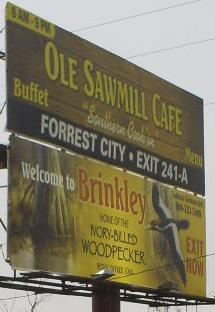
Hometown? - Although Brinkley considers itself the hometown of the rediscovered Ivory-Billed Woodpecker, other Arkansas residents claimed to have seen the bird in the Southeast portion of the state.

Just down the road, a billboard boasts “Brinkley, Home of the Ivory-Billed Woodpecker” in reference to the 2004 rediscovery of the bird once thought extinct. The grainy footage caught by researchers led some to claim that the stories of this rediscovery are just wives tales. To be honest, even if it’s only a story, it does not matter.

While attending the University of Tennessee, I’d travel back and forth between Knoxville and Little Rock. On more than one occasion, I took the Brinkley/Cotton Plant exit for a gas stop. The discovery of the Lord God Bird made a remarkable change to this area.

Inn.JPG

Just west of town next to the interstate stands a new convention center. Where once stood an abandoned-looking hotel, now the Ivory Billed Inn beckons tourists from around the world hoping to gain a glimpse of what they once believed to be extinct.

In short, the idea of the "The Lord God Bird" still being alive despite man’s destruction of its habitat keeps hope alive, and that’s priceless.

Of course, I have heard tales of the Ivory Billed Woodpecker being seen as far south as Crossett. With the waterways and woods of eastern Arkansas, I find it easy to believe the bird surely must be somewhere amongst those trees.

Upon finally making it back to Memphis, I had to stop in midtown at Shang Hai Oriental Restaurant on Poplar Avenue to eat Vietnamese food. I enjoyed the Pad Khing with shrimp before heading back to the conference. I’m also enjoying the free WiFi provided at the conference, though sometimes it goes in and out. I had to switch to a landline just to get on again. :(

How Do You Make It Pay?

By Ronald Sitton

Memphis (Jan. 12) – During Friday's “Building and Sustaining Independent Media” breakout session, the presenters overviewed their individual independent outlets and suggested how the independent media landscape could be strengthened, yet they could only suggest diversifying when trying to answer the most-asked question of the afternoon: how can independent media make money?

Kim Spencer, executive director of Link TV, said the key to profitability rests in a variety of funding sources. While that may seem obvious, Bonnie Boswell of The Real News took it a step further, noting that the proposed international independent news network would rely on individuals as the primary source of funding, in essence creating a publicly driven media source.

“We intend to have no government financing or advertising,” Boswell said. “We’ve raised $5 million and intend to raise $15 million more. If we can get 250,000 people to give $10 a month then you can be independent.”

Moderator Tracy Van Slyke, publisher of the 30-year-old independent national award-winning news magazine In These Times, noted while independent media may be poor in capital, it boasts rich content. In hopes of increasing the reach of that content, many of the organizations joined Mediaconsortium.org – a network of 35 progressive media organizations filling a void created by the loss of organizations like the Independent Press Association, which folded over a week ago.

“Many funders don’t understand the need for funding of the progressive media landscape,” Vans Slyke said.

Diversifying applies to more than just funding. Van Slyke claimed independent media must be willing to use multiple platforms for the message if they expect to not only survive, but thrive. Andre Banks, publisher of ColorLines, noted that while it’s hard to raise money for media ventures, his publication went through many incarnations over its 10 years of existence reporting on communities of color. To help reach a larger variety of consumers, Banks said the publication often repackages information from one story to use in another story or as a query to invite reader response and build community.

“We’ve tried reshaping our Website and opening a blog,” Banks said. “In terms of our theory of social networking online, we want to use social networking online to move to offline action.”

Not only are consumers taking notice, but apparently, corporate media also keeps an eye on his site. Banks said larger publications like the New York Times used the same angle and the same actual sources on articles originally appearing in ColorLines.

Cenk Uygur described how The Young Turks benefited from forging ahead rather than thinking about how to use different media. The creators of The Young Turks went to Sirius Radio and asked to start a show. After making a demo, they became the first talk radio show on satellite.

“We’re not thinking about doing it,” he said. “The minute we think about doing it, we’re doing it. The worst that can happen, you try it, it doesn’t work out. Who cares?”

Although they initially claimed 423 subscribers, Uygur said the 5-year-old program benefited from WhiteRoseSociety.org archiving old shows. Now the program also boasts an Internet site where people can watch the show 24 hours a day.

Spencer said LinkTV also benefited from the expansion of other media, noting his company provided video to Google when that company launched. The company boasts Web archives of 1,200 episodes of news from the Middle East since 2001.

“Having the impact on the mainstream media is very important to us,” he said. “We know the White House and the state department monitor what’s happening in Mosaic everyday.”

Spencer said LinkTV uses surveys to determine not only who its viewers are, but also if they actually get involved after watching a program. According to surveys, he said 50 percent said they got involved in a dialogue, 27 percent said they’ve got involved politically, and others contributed to a group after watching a LinkTV program.

Banks said ColorLines invites consumers to talk across cultures about the way race has a part in politics. Though some may claim the outlet produces biased journalism, Banks disagrees.

“The only reason the kind of journalism we do can be considered advocacy journalism is the shift to the right of regular journalism,” he said. “We’re helping people to see is what they need is information. This is about reeducating our population about what journalism is all about.”

Boswell took the idea a step further.

“The truth is being defined by people at any given time,” she said. “We want to give people facts and let them decide at any time of their life.”

January 12, 2007

Jackson Invokes King's Memory, Purpose

by Ronald Sitton

jackson2.jpg
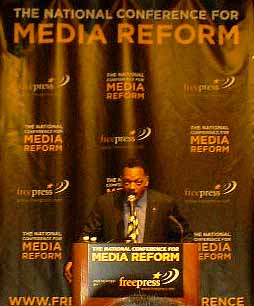
Continuing the Fight - Rev. Jesse Jackson finishes his speech at the National Conference for Media Reform. Jackson urged participants to continue the fight to keep independent media alive and well.
MEMPHIS (Jan. 12) - Rev. Jesse Jackson told a gathered crowd of approximately 2,500 and an additional 2,000 watching the event through streaming media on freepress.net that President George W. Bush is a war addict who needs some type of methadone.

"The president is in a hole looking for a shelter rather than a rope," Jackson said.

While he occasionally referred back to the president, Jackson used the forum to speak about the upcoming national Martin Luther King, Jr. holiday and claimed that romanticizing King’s legacy takes away from the struggle of today.

In a rather poignant moment, Jackson spoke of King’s last hours before coming to Memphis, noting King spent his birthday at home with family and in the basement of his church trying to decide how to end poverty and to end the war. Jackson said King almost gave up the struggle the morning before coming to Memphis due to the accomplishments of the Civil Rights movement, comparing King’s indecision to that of Jesus in the garden of Gethsemane prior to his crucifixion.

Jackson then spoke of the problems of the affirmative action movement, noting the main beneficiaries of affirmative action has been white women through Title IX legislation allowing equal competition in sports. But he claimed many young white female beneficiaries are against affirmative action because they don’t hear the truth of affirmative action in mass media.

“I’m concerned that the media has the capacity to make America better,” Jackson said. “We must fight to open the airwaves for all people.”

Jackson said corporate ownership of media may be a small part of the bottom line for corporations, but it’s a big part of the propaganda to continue the war that’s profiting the corporations.

“Why can’t we fight to expand the leadership and ownership of local media?” Jackson asked, noting that corporate media marginalizes his position by seeking his opinion on the Duke lacrosse team and comedian Michael Richards, but refusing to ask his opinion on the Iraq war.

“Why pigeonhole me to respond to a broke-down comedian and not talk about war and peace? Don’t just talk about Michael Richards; talk about Arsenio Hall 15 years ago so Bill Clinton could play his saxophone, but now there’s no black comedian on primetime television,” Jackson pined, calling the major news networks “All Day, All Night, All White” to the applause of the conference attendees. “I have an opinion about Iraq … It’s like a cross-eyed archer, you’re shooting the wrong target.”

Jackson praised Nancy Pelosi’s rise to Speaker of the House and claimed Bush makes the idea of a woman or black president more plausible every day. But Jackson said more needs to be done to start new jobs instead of raising the minimum wage, which doesn’t help the unemployed.

“We need bold leadership, not baby steps,” he said. “Katrina is a metaphor for abandon urban American. Stop bombing Iraq and reinvest in America. Put our children back n school and their parents back to work.”

Jackson then praised those in attendance.

“Free press, you have the power to redeem the soul of America. Keep writing your story. Report your story. … We hear so much nonsense, that sense doesn’t seem to make sense. But tell it anyhow,” he said.

Jackson claimed that though the major networks are not covering the conference, “their spies are here, they know what’s going on.” The statement brought a laugh from the crowd and more than a few heads turning to see if they could spot the spies.

Jackson finished by leading the crowd in a chant of “Stop the war, save the children. We’re all somebody. Everybody is necessary. Don’t let them break your spirit. Keep fighting back. Keep hope alive. Keep hope alive. Keep hope alive.”

Afterwards, a freepress representative told the crowd that the Internet service provider was having problems from people attempting to watch the conference online.

Jackson reminded everyone of an upcoming demonstration to stop the war in Washington, D.C. on Jan. 27 when he initially came onstage.

I’m off to catch a break-out session and plan to post pictures later this evening when I get the right cord for the job.

Looking Forward Rather than Looking Back

By Ronald Sitton

schwag.jpg
Schwag - The conference fees paid for this tote bag, book, magazines and access to a Friday night concert featuring the North Mississippi All Stars among other things.


MEMPHIS (Jan. 12) - I've just pulled into Memphis and made it to the Conference Hall for the National Conference for Media Reform.

Slate-gray skies and a steady mist took me from Little Rock to the City of the Blues this morning. It's almost winter in the Delta; the weather-niks even forecast cold temperatures for next week. As I drove I thought that regardless of your views on global warming, no one can deny the weather cycles strayed from normal over the past decade.

The Black Keys' Magic Potion provided a soundtrack as I looked across the landscapes that urbanites deride as monotonous but farmers appreciate as fields of gold. Yet when it takes Coca Cola's plight of perhaps losing its winter icon, the polar bear, to make the current administration use the term "global warming," I wonder if we can make "dilemonade" out of the dilemma confronting mankind with the current leadership lacking in powerful places. We passed the point of preventing the problem; pray we can mitigate the effects.

Sometimes as I pass the Super Uninformed Victims clogging the road and our air, I wish I owned a bumper sticker asking, "Suckin' Gas?" But what's a fella to do when our government provides a $100,000 tax credit to buy a gas hog versus a $4,000 credit to buy a hybrid that gets better than 60 mpg at 55 mph?

What does this have to do with media reform, you ask?

When does our corporate-controlled media even discuss climate problems? It takes a polar bear and a tumbling iceberg for the video clip and a great soundbyte to even get a few minutes a month in most locales.

Thanks to the National Wildlife Federation, I plan to show "An Inconvenient Truth" to the Arkansas-Monticello campus community next week. Although I think the overall message is good, I worry that the film's mention of the 2000 election will turn off the minds of those who most need to hear the message. When we keep looking back, we miss what's coming and the opportunity to do anything about it.

That's why I'm in Memphis. Although I missed Bill Moyers' opening plenary, the thunderous applause at the end of his speech echoed through the hallway outside Ballroom D. I'm hoping to hear some people who are looking forward and trying to fix the problems before they become dilemmas. You can only make so much dilemonade.

BTW, I just met Charles D. Jackson, National Press Director of ACORN, and they're looking for a paid station manager for Little Rock's community radio station KABF. For more information, e-mail acorncomm@acorn.org.

January 07, 2007

Caring More About Football Than Global Warming

gwcubamug.jpg

Connecting the Dots
by Glynn Wilson

TUSCALOOSA, Ala., Jan. 7 - It is 72 degrees in mid-January and still drizzling rain in T-Town. It looks like global warming is taking a toll after six years of being denied and ignored by the Bush administration.

All the national news organizations are focusing on what Bush will say in an address to the nation this week about the quagmire in Iraq.

Trial balloons are being floated over the airwaves saying he will propose sending anywhere from 20,000 to 40,000 more troops to face the growing insurgency there. Not many Republicans or Democrats think that will be enough troops to do much good, and most of the Democrats think it will just do more harm than good.

The notable exception is Republican Senator John McCain of Arizona, who wants to run for president in 2008 and thinks the only path to that success will be some sort of "victory" in Iraq.

coach3.jpg
Photo by Glynn Wilson
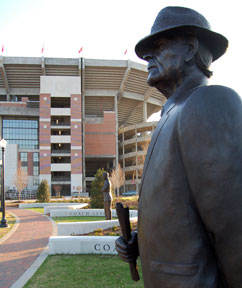
"Bear" Bryant's image casts a shadow over Tuscaloosa.

Meanwhile back at the Christian-Republican ranch in Alabamaland, all the buzz is about the University of Alabama's success in recruiting Nick Saban to take over the UA football program.

The only war that really matters here is the one between the Crimson Tide and a smattering of orange-clad opponents on the gridiron, most notably the Auburn tigers and the Tennessee volunteers.

As usual I am torn between the glaring contradictions.

While the people of Alabama claim to be deeply Christian, their Bible clearly says in the venerated Ten Commandments, "Thou shalt have no other gods before Me ... Thou shalt not make unto thee any graven image"

Yet towering over the psyche of this place is a granite statue of the winning football coach Paul "Bear" Bryant. And as we reported this week before the Saban press conference, there is an empty spot on the "walk of champions" in front of the newly expanded Bryant-Denny Stadium for a new statue for the next coach who wins a national championship.

And just about everyone around here, including virtually every sports writer at every local newspaper, thinks Saban has what it takes to capture that spot in college football history - even if the national sports press corps thinks Saban is a liar.

The opinion and theory that Saban will be a winner here will be tested on the football fields of the Southeastern Conference and beyond.

What I want to know is: When will the people of Alabama and the local news media start caring as much about good government as they do about a winning football program? When will they get as tough on politicians are they are on football coaches?

If a football program is a business and the coach should be treated as a CEO, then shouldn't we think of government in the same way? If George W. Bush was the CEO of a corporation - or a football coach - he would have been fired in 2004.

But the people elected him again for another four years and the mainstream press for the most part went along with it and even endorsed him.

So much for the theory of the "liberal media."

Now that the Democrats have taken back control of both houses of Congress, there are many of us out here wondering if they will play the role of a national board of directors - and fire Bush by impeaching him and removing him from office.

The people and the press in Alabama so wanted former Gov. Don Siegelman and HealthSouth founder Richard Scrushy to go to jail for their alleged crimes. Where is the outrage over Bush's crimes against nature and humanity?

If we had elected Al Gore in 2000, we would live in a different world today - a world with no quagmire in Iraq and perhaps some progress by now in dealing with global warming.

But no, the oil companies and corporate CEOs have gotten richer under Bush's watch - and we've done absolutely nothing to deal with the growing threat to the planet from climate change and the greenhouse effect due to the burning of fossil fuels.

Maybe we will start caring about that issue when the beaches of Gulf Shores erode north to Bay Minette.

Related stories:
Alabama Fans: Meet Nick Saban
Tide Faithful Goes Nuts Over Saban's Arrival